
———— Release time:2021-01-11 Edit: Read:36 ————
Some friends asked Yesterday:
What role can Blockchain play in anti-counterfeiting and traceability?
Here is my answer:
We often use "anti-counterfeiting traceability" as a term, but in fact the two are different.
Physical and digital anti-counterfeiting technologies include digital watermarks (such as our banknotes and some seals with subtle digital information), biometric anti-counterfeiting (such as embedding the creator’s DNA into the art production materials, or using the password as a packaging weave method) is the main means of anti-counterfeiting.
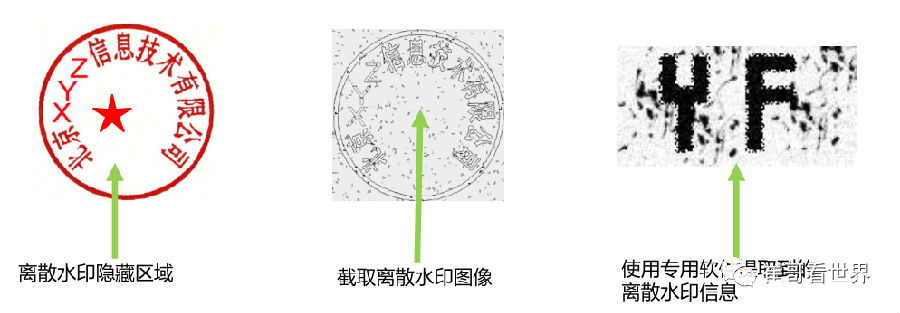
Digital watermark example
Bblockchain itself cannot play an anti-counterfeiting role because it cannot verify the authenticity of physical objects. Blockchain itself is a digital technology (or rather, distributed storage technology and some distributed incentive models derived from it).
Therefore, there are some so-called blockchain anti-counterfeiting in the market, which is conceptually imprecise. A common example is printing a QR code on a wine bottle, and the user can scan it to see the product information. This can only prove that the QR code is true, but it cannot prove that the wine in the bottle is the bottle of wine corresponding to the QR code. Various blockchain rice, blockchain chicken, etc., and so on can be deduced by analogy.
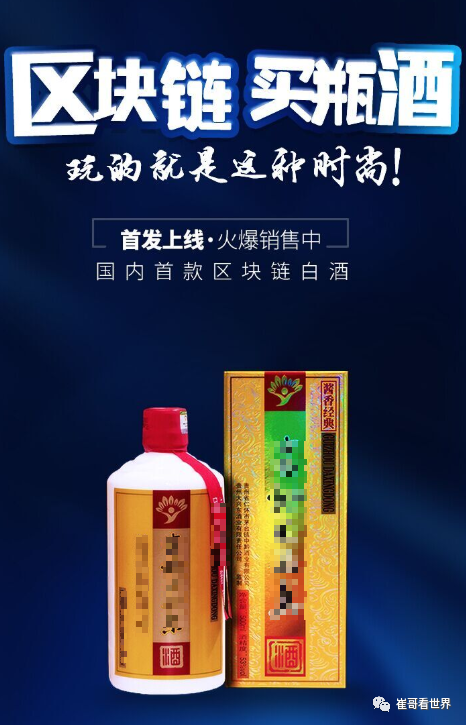
Such products emerge endlessly in the market
But in terms of traceability, digital technology represented by blockchain can play a certain role. The traceability mentioned here is not only about finding the source, because this is anti-counterfeiting, but rather: collecting complete path (Trace/Audit Trail) information in the process of product circulation.
For example, in the case of a file with a digital watermark, after the file is stamped with digital watermark technology, the authenticity of the endorsement can be greatly improved. This just solves the need for anti-counterfeiting.
However, if the user needs to understand the entire process of the file from generation, submission, approval to final archiving, obviously a single anti-counterfeiting data is not enough to constitute this traceability chain.
At this time, it is necessary for all parties involved in the entire file processing process to put the process information together in a unified form and standard, and the process information itself needs to be secure.
However, if it is within the same unit, then only a centralized database, strict permission management and simple operation interface are needed to achieve this goal.
However, if it involves different departments of multiple units, even government units and enterprises in different regions and at different levels, and there may be scanners, IoT terminal devices, manual input and other forms on the collection side, then there is one issue that is how to unify the data format, how to trust each other (that is, "how do I ensure that you do not modify my process information"). In this case, Blockchain technology (in fact, to put it simpler, that is, distributed data processing and storage, plus relatively transparent data monitoring) can play a certain role. As for what is Blockchain technology and why it works, please refer to my previous article:
Explain Blockchain in three minutes a day: What are the characteristics of Blockchain?
Explain Blockchain in three minutes a day: What does "decentralization" mean?
An article to understand the history, current situation and opportunities of Blockchain industry.
So my view can be summarized as:
What technology to use depends firstly on what problem you want to solve. For processes that only require anti-counterfeiting, or only occur within the same unit (the internal trust problem is not serious, or does not exist at all), then there is no need to adopt the distributed technology of Blockchain. If it involves collaboration between multiple parties, Blockchain can provide a solution.
Of course, the most ideal solution is to use special watermarks or biological means for anti-counterfeiting, and blockchain for traceability. The both make a formidable combination.
Taking the cold chain logistics of seafood and medicines as an example, the regulatory authorities and consumers must not only know that this fish is a real "salmon" (not rainbow trout), but also know whether the detailed information about the fish during transportation and storage meet the requirements of cold chain logistics. This requires us to consider both anti-counterfeiting and traceability.
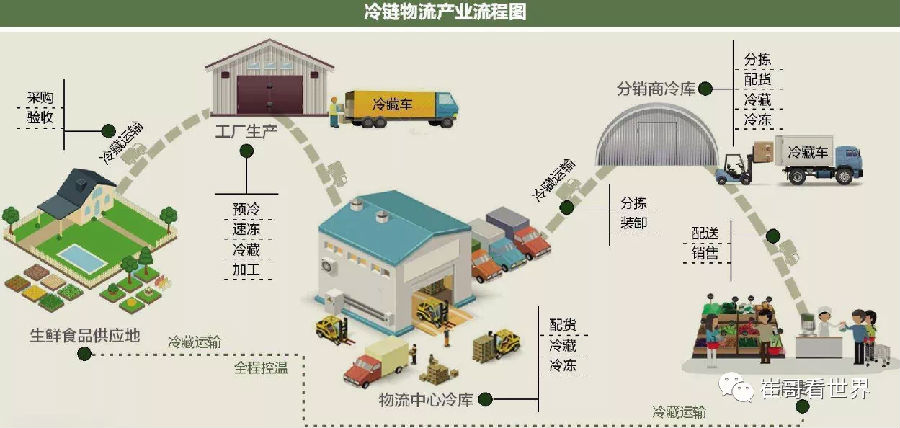
Cold chain industry flow chart
Insert a sentence here:
In fact, most of the current deployment methods of cloud services are also distributed, with the goal of improving processing efficiency, capacity expansion, and adapting to micro-service operation and maintenance.
In the past, everyone tried to improve the performance of a single machine. Later, Google launched a distributed three-piece (distributed file system GFS, big data distributed computing framework MapReduce and NoSQL database system BigTable). You found that you can organize a large number of ordinary machines together, deploy a large-scale server cluster, store massive amounts of data on this cluster in a distributed manner, and then use all machines on the cluster to perform data calculations. In this way, in fact, you can achieve very powerful storage and computing performance without having to buy a lot of expensive servers. Compared with these distributed architectures, the main difference between Blockchain and these distributed architectures lies in the data structure and incentive methods.
Recap history
Having said that, in practice, what I see is a common situation: Many enterprises and institutions, let alone distributed, have not even achieved centralized digitalization.
There are still a large number of manual processes in the processing of files, files, information, and data, making approvals cumbersome and redundant. This is the actual situation.
So when I solve these problems, I will use Blockchain, the Internet, or even just ordinary OA systems as a starting point to solve the most urgent problems faced by enterprises and governments.
After all, the technology that solves the problem is the best technology.
This is my answer to this question for your reference.
